IMPORTANT NOTICE

This website is not intended for the UK audience. If you are accessing this website from the UK, please exit this site immediately. Please be informed that services offered on this website are currently not accessible to Retail Clients based in the UK.

Onchain Finance Explained: A Review by Bintense


Originally published on Startup Info.

This article and its content have been produced and disseminated to persons outside the United Kingdom. The information provided is not directed at or intended for distribution to, or use by, any person or entity located within the UK. The financial products and services mentioned in this article are not eligible for the UK. Cryptoassets are classified as Restricted Mass Market Investments in the UK, meaning they are high-risk investments unsuitable for most retail investors.

As the landscape of cryptocurrency and blockchain technology evolves, Bintense, a regulated Lithuanian crypto exchange, believes it is essential to stay ahead of the concepts shaping tomorrow’s financial systems. One of the most important trends of recent years is Onchain Finance—sometimes referred to as OnFi. Far from just another buzzword, it describes the migration of financial services from traditional centralized infrastructure to decentralized, blockchain-based networks.

What Is Onchain Finance?

On-chain Finance refers to financial transactions and services that operate directly on blockchain networks rather than relying on banks, brokers, or other intermediaries. Instead of paper contracts or centralized databases, ownership, transfers, and agreements are executed via smart contracts—self-executing pieces of code on the blockchain.

This means that lending, exchanging, payments, and asset management can take place in a system that is transparent, auditable, and global by design.

Why Does It Matter?

For decades, financial systems have relied on middlemen—clearing houses, custodians, and payment networks. These processes can be slow, opaque, and costly. Onchain Finance aims to solve these problems:

  • Transparency: Every transaction is recorded on a shared ledger, open for audit.
  • Resilience: With no single point of failure, decentralized networks can remain operational even if parts of the system go offline.
  • Speed: Settlements happen in minutes, not days.
  • Accessibility: Anyone with an internet connection can participate, expanding access to previously excluded populations.
  • Programmability: Smart contracts enable new products—like automated lending, tokenized real estate, or decentralized insurance.

This shift doesn’t just replicate existing finance on a blockchain; it opens doors to entirely new models of collaboration and value exchange.

Tokenization: The Cornerstone of Onchain Finance

One of the most powerful features of OnFi is asset tokenization. Here, real-world assets—such as property, stocks, or commodities—are represented digitally on a blockchain. A token acts as proof of ownership and can be transferred instantly between parties.

This approach promises to increase liquidity in traditionally illiquid markets, reduce barriers to entry, and simplify cross-border investment.

Challenges Ahead

While Onchain Finance carries clear advantages, it is not without hurdles. Scalability of blockchains, regulatory uncertainty, and the complexity of integrating legacy financial institutions remain challenges. Moreover, the security of smart contracts—while robust—depends on the robustness of the code itself.

Why Bintense Reviews Onchain Finance

At Bintense, we view Onchain Finance as a crucial step in the broader adoption of digital assets. As a regulated cryptocurrency exchange registered in Lithuania, Bintense focuses on Bitcoin and Ethereum — the two assets most deeply integrated into the on-chain ecosystem.

Bintense requires KYC verification for compliance and security, and it offers direct exchange: users do not hold funds on the platform but transact directly from their wallet, bank card, or account. This design gives individuals greater control over their assets while benefiting from the protections of a regulated environment.

By monitoring trends like  Onchain Finance, Bintense helps users understand not only how to exchange crypto today but also how digital assets are shaping the financial systems of tomorrow.

Onchain Finance is more than a buzzword—it is the foundation for a new era of open, programmable, and inclusive finance. From tokenized assets to real-time settlement, the possibilities extend far beyond speculation.

For anyone looking to navigate this changing world, staying informed is the first step. And that’s where Bintense positions itself: not only as an exchange for BTC and ETH, but as a guide to the innovations driving the future of money.


World Mobile’s Blockchain-Backed 5G Network: A New Chapter in Connectivity


Originally published on Techy Sumo.

This article and its content have been produced and disseminated to persons outside the United Kingdom. The information provided is not directed at or intended for distribution to, or use by, any person or entity located within the UK. The financial products and services mentioned in this article are not eligible for the UK. Cryptoassets are classified as Restricted Mass Market Investments in the UK, meaning they are high-risk investments unsuitable for most retail investors.

As the landscape of cryptocurrency and blockchain technology evolves, Bintense, a regulated online crypto  exchange from Lithuania, believes it is impossible to remain on the sidelines. Innovations like World Mobile’s latest initiative — a blockchain-powered 5G network delivered via stratospheric drones — highlight how blockchain continues to reshape industries far beyond finance. At Bintense, we review these groundbreaking developments to keep our users informed of the trends that will define the digital future.

Taking Blockchain to the Skies

World Mobile, in partnership with Indonesian telecom Protelindo, has announced the launch of World Mobile Stratospheric — a 5G network powered by hydrogen-fueled drones flying at 60,000 feet. Each aircraft can remain airborne for nine days and cover up to 15,000 square kilometers, providing low-latency, high-speed connectivity. Unlike satellite systems that target remote regions, this initiative is designed to integrate into existing mobile networks and strengthen coverage in densely populated areas.

Market Potential and Engineering Challenges

The project positions itself within the €89.7 billion sky-based communications market, projected to expand to €145.1 billion by 2030. While the potential is vast, operating in the stratosphere presents unique hurdles: lightweight yet durable construction, resistance to temperature extremes, radiation protection, and compliance with strict aviation regulations.

If successful, World Mobile Stratospheric could offer an entirely new model of connectivity, bridging blockchain with telecom infrastructure and pushing the industry toward decentralised, user-powered ecosystems.

Why It Matters for the Blockchain Ecosystem

This initiative demonstrates how blockchain is expanding its utility beyond financial applications. By embedding blockchain into telecom services, World Mobile is creating a decentralised physical infrastructure network (DePin) that combines traditional assets with independent providers. This hybrid model could redefine how connectivity is delivered, setting a precedent for other industries to explore blockchain-backed infrastructure.

Bintense’s Perspective

For Bintense, the lesson is clear: blockchain is no longer confined to payments or exchanges. It is becoming an enabling technology across sectors. As a regulated exchange registered in Lithuania, Bintense provides users with direct access to Bitcoin and Ethereum  while also monitoring and analysing the broader blockchain landscape. Keeping our community updated on such developments ensures that our users remain not only participants in the digital economy but also informed observers of its evolution.

What You Need to Know Before Using Crypto: A Practical Knowledge Checklist for Beginners

As cryptocurrency continues to move from the margins into everyday use, enabling payments, transfers, and digital ownership, more people are beginning to interact with it directly. But while access to crypto has become easier, understanding how it works remains essential.

For those new to the space, it’s not about becoming a developer or blockchain expert. It’s about knowing enough to use crypto confidently, correctly, and securely. Bintense team breaks down of the core knowledge areas every new user should understand before sending or receiving digital assets.

Table of Contents

  1. What a Blockchain Does
  2. Wallets: Types, Functions, and Responsibilities
  3. How Transactions Work
  4. Basic On-Chain Safety and Fraud Awareness
  5. The Role of Exchanges and Conversion Tools
  6. Why This Knowledge Matters
  7. Learning Crypto at Your Own Pace

What a Blockchain Does

At the core of every cryptocurrency is a blockchain — a distributed ledger that records transactions across a network. It’s not just a buzzword; it determines how data is validated, stored, and protected.

Understanding how a blockchain confirms a transaction, what a block contains, and why decentralization is necessary can help users grasp why cryptocurrency is considered tamper-resistant and how it differs from traditional databases.

Wallets: Types, Functions, and Responsibilities

A crypto wallet doesn’t “store” coins in the way a bank account holds money. Instead, it manages the private keys that allow users to authorize transactions on the blockchain.

New users should understand the distinction between custodial and non-custodial wallets, how backup phrases (also known as seed phrases) function, and why private key management is a non-negotiable aspect of cryptocurrency security. Understanding wallets also reduces the risk of loss or unauthorized access.

Altcoin Searches Hit Multi-Year Highs: What Google Trends Reveal About the Next Crypto Wave


Originally published on TuxNews.

This article and its content have been produced and disseminated to persons outside the United Kingdom. The information provided is not directed at or intended for distribution to, or use by, any person or entity located within the UK. The financial products and services mentioned in this article are not eligible for the UK. Cryptoassets are classified as Restricted Mass Market Investments in the UK, meaning they are high-risk investments unsuitable for most retail investors.

Crypto markets are once again drawing significant retail and institutional attention. According to Google Trends data, searches for “altcoin” have reached their highest level in five years, while searches for “Ethereum” are at a two-year peak. This rise in online curiosity coincides with Bitcoin’s market dominance slipping toward the 59–61% range — a band that in past cycles has often signaled the start of a broader “altseason.” Bintense, a regulated Lithuanian crypto exchange, reviews the trends of user interest. 

At the same time, institutional capital is flowing into the sector at a record pace. Digital asset funds attracted €3.96 billion in inflows in late July, with Ethereum alone accounting for €1.95 billion, nearly doubling its previous record. At the same time, the industry’s Total Value Locked (TVL) reached a new all-time high of €276.46 billion, creating conditions for a possible expansion in the altcoin market.

The Cyclical Nature of Crypto Interest 

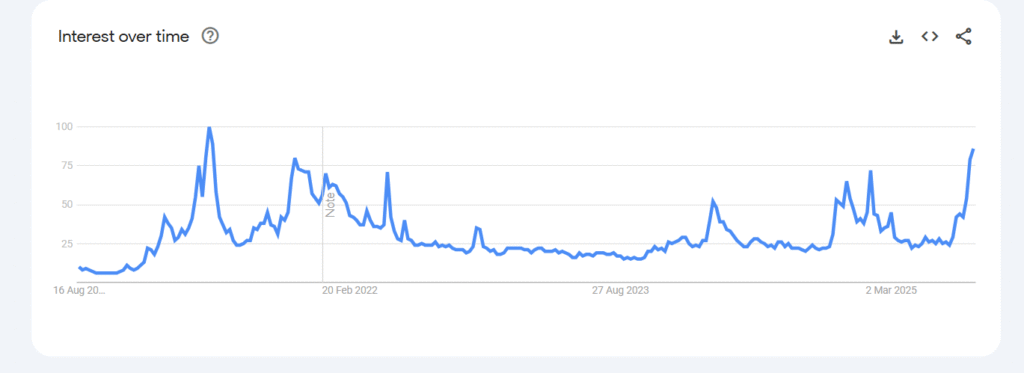
While today’s surge in search activity is striking, a look at the past five years of Google search data (see chart) tells an important story: crypto interest does not rise steadily — it comes in waves.

Google Trends, interest over time, term: Crypto, setting: Worldwide, period: Last 5 years

The chart shows strong spikes in early 2021 and late 2021, a sharp decline through 2022, and a prolonged period of lower interest throughout 2023. Only in 2024–2025 does attention begin climbing again, leading to today’s highs.

This pattern reflects the cyclical nature of the crypto market itself:

  • Interest surges during major rallies.
  • Declines set in during consolidation phases.
  • Renewed attention arrives when prices and narratives regain momentum.

In other words, search data confirms that crypto remains a sentiment-driven market. Peaks in curiosity often precede or accompany periods of intense user activity, while lulls reflect consolidation phases where broader attention fades.

Why Bitcoin Still Holds the Key

Altcoin momentum today depends heavily on Bitcoin’s behavior. Historically, when Bitcoin consolidates and its dominance dips, capital flows into alternative assets. But if Bitcoin were to regain dominance toward the mid-60% level or higher, history suggests the altcoin rally could stall.

Thus, while Ethereum’s surge above €4,145 and the growing institutional enthusiasm are promising, the overall trajectory still depends heavily on Bitcoin’s market position.

Where Bintense Fits In

For users looking to take part in this shifting landscape, Bintense provides a regulated and transparent gateway into crypto.

Registered in Lithuania, Bintense enables the exchange of Bitcoin (BTC) and Ethereum (ETH) — the two assets most central to today’s market trends. The platform operates on a direct-exchange model:

  • No need to deposit funds into internal accounts.
  • Payments are made directly from your wallet or bank account.
  • Proceeds are returned directly to your wallet or bank account.

This approach ensures users maintain control over their assets at all times. In addition, Bintense applies full KYC verification, aligning with EU regulatory requirements and supporting a compliant exchange environment.

The latest spike in Google searches shows that crypto is once again in the spotlight, especially beyond Bitcoin. Institutional flows, Ethereum’s strength, and retail curiosity suggest momentum is building toward another altcoin cycle. Yet the five-year trend also reminds us that crypto interest is not a straight line, but a sequence of rises and corrections.

For those seeking a straightforward and regulated way to exchange Bitcoin and Ethereum during this new wave of attention, Bintense offers a clear and compliant path.

What Is a Direct Crypto Exchange? A Closer Look at Bintense in Lithuania


Originally published on JP.lt.

This article and its content have been produced and disseminated to persons outside the United Kingdom. The information provided is not directed at or intended for distribution to, or use by, any person or entity located within the UK. The financial products and services mentioned in this article are not eligible for the UK. Cryptoassets are classified as Restricted Mass Market Investments in the UK, meaning they are high-risk investments unsuitable for most retail investors. 

A Different Approach to Crypto Exchanges

Most exchanges ask users to deposit funds first into internal accounts before making the first transaction. That means leaving money in the custody of the exchange until it’s withdrawn. Bintense takes a different path. Operating as a direct exchange, it allows users to remain in control of their money at all times. Payments are made directly from a card or wallet, and proceeds return directly the same way — no prefunding, no exchange-held balances.

First Impressions of the Website

Bintense presents itself with clarity. The homepage avoids the busy charts and tickers seen on many platforms. Instead, it walks newcomers through a simple process: register, verify, and exchange. The focus is not on speculation or complex features, but on offering Bitcoin and Ethereum exchanges in the most straightforward manner possible.

How Direct Exchange Works in Practice

The mechanics reflect the platform’s philosophy. When buying, users pay directly from their bank account or card, with coins sent straight to their external wallet. When selling, crypto leaves the user’s wallet, and fiat returns to their account. At no point does Bintense act as a custodian of customer balances. This reduces risks associated with holding funds on third-party platforms and appeals to those wary of centralized custody.

Verification as a Regulatory Requirement

While the model is direct, it is not anonymous. Being a regulated Lithuanian exchange, Bintense enforces a thorough KYC process. Verification requirements scale with transaction size and can include ID documents, proof of address, and sometimes video verification. Though some users may see this as demanding, it is standard under EU compliance rules and necessary for a licensed service.

Transparency and Customer Support

Another defining feature is transparency. Bintense discloses fees upfront, ensuring no hidden charges. The platform also makes it clear that it is not a wallet provider — customers are expected to manage their own Bitcoin or Ethereum wallets. To support them, the site offers guidance, an FAQ library, and a blog covering topics like security and regulatory obligations. A 24/7 contact option is also available for technical issues.

A Lithuanian-Regulated Service

Green Cliff Inc. operates Bintense and is officially registered in Lithuania, an EU jurisdiction known for its regulatory oversight of crypto service providers. This status adds credibility for users seeking reassurance that they are dealing with a licensed entity in a regulated environment.

Bintense is not positioned as a hub for traders or those seeking dozens of tokens. Its value lies in its direct exchange model, which allows newcomers and everyday users to move between fiat and crypto — specifically Bitcoin and Ethereum — without ever giving up control of their funds. For many, this simplicity and regulatory backing may be exactly what they want from a crypto exchange.

Bintense Review: A Practical Guide for Users

Bintense is a cryptocurrency exchange platform where users can exchange Bitcoin (BTC) and Ethereum (ETH). The platform simplifies the exchange process, enabling direct transactions that are sent directly to your wallet, bank account, or credit card. Here’s a comprehensive look at how Bintense works and what you need to know before using it.

What Bintense Offers

Bintense allows users to exchange Bitcoin and Ethereum. After completing the transaction, you will receive the cryptocurrency directly in your wallet or have it transferred to your bank or credit card account. This direct method eliminates the need to deposit funds into the exchange.

Why Do You Need KYC?

Bintense follows regulatory requirements and uses KYC (Know Your Customer) to ensure that all users are verified before using the platform. Completing the KYC process ensures compliance with laws designed to prevent fraud, money laundering, and other illicit activities. While it may seem like an extra step, KYC is necessary for regulated platforms like Bintense.

How to Complete KYC on Bintense

To get started with Bintense, you need to complete the KYC process. Here’s how it works:

  • Create an Account

Register on the platform by entering your basic details and confirming your email address.

  • Verify Your Identity

Submit a valid ID (passport, driver’s license, or government-issued ID) and proof of address (utility bill or bank statement). These documents help verify your identity and confirm your place of residence.

  • Video Verification

Complete a video verification call to confirm your identity in real time. This is a standard procedure for regulated platforms.

  • Submit Additional Documents

Depending on the volume of your transactions, you may need to provide additional documents, such as a Source of Funds declaration.

Once all required documents are submitted, Bintense will review and approve your account. This process can take anywhere from a few hours to a few days, depending on the platform’s verification procedures.

How to Make an Exchange

Once KYC is complete, you can begin exchanging Bitcoin or Ethereum. Here’s the simple process:

  • Choose the Cryptocurrency

Select Bitcoin or Ethereum for your exchange.

  • Set the Amount

Enter the amount of cryptocurrency you wish to exchange.

  • Pay for the Transaction

You’ll need to pay for the exchange, and once payment is confirmed, the funds will be transferred directly to your wallet or sent to your bank or credit card account.

  • Transaction Processing

After your payment is confirmed, the transaction will be processed. Bintense ensures that the transaction follows all necessary steps to be completed.

Bintense provides a clear and structured way for users to exchange Bitcoin and Ethereum. The platform enables you to make direct payments for transactions and receive cryptocurrency into your wallet, bank account, or credit card account. With a simple registration and KYC process, Bintense ensures that users comply with necessary regulations.

If you’re looking for a regulated and transparent way to exchange Bitcoin and Ethereum, Bintense offers a straightforward option. The platform’s focus on compliance and user verif

Bintense Explains: Custodial vs. Non-Custodial in Crypto and Why It Matters


Originally published on Coingabbar.

This article and its content have been produced and disseminated to persons outside the United Kingdom. The information provided is not directed at or intended for distribution to, or use by, any person or entity located within the UK. The financial products and services mentioned in this article are not eligible for the UK. Cryptoassets are classified as Restricted Mass Market Investments in the UK, meaning they are high-risk investments unsuitable for most retail investors.


When Bitcoin first appeared in 2009, its purpose was clear: to create a system where people could manage digital money directly, without intermediaries. Today, the distinction between custodial and non-custodial models defines how this vision is applied in practice. As a regulated crypto exchange, Bintense explains why this difference matters and how it shapes the way users interact with their digital assets.

What Does Custodial Mean?

A custodial platform is one where the company holds crypto assets on its internal accounts. Users get access through a login, but the platform manages the actual crypto. This setup feels familiar, but it also means handing over control. If the custodian freezes withdrawals or faces operational issues, users may not be able to access their balances.

What About Non-Custodial?

In a non-custodial model, the user stays in control. Funds go directly to personal wallets, and there are no platform-controlled balances. This approach demands a bit more personal responsibility — like managing your wallet and making sure addresses are correct — but it keeps ownership where it belongs: with the individual.

Bintense in This Paradigm

Bintense was designed with the non-custodial principle at its core. We don’t hold your money — not crypto, not fiat. Every exchange you make happens directly:

  • From your wallet or bank account → to your wallet or bank account.
  • No internal accounts, no balances “stored” on the platform.
  • The process is streamlined and transparent.

This approach keeps Bintense aligned with the original idea behind blockchain: giving people direct control over their digital transactions without unnecessary middle layers.

Why It Matters

As crypto evolves, many solutions are starting to look like the very systems it was meant to move beyond. By staying non-custodial, Bintense continues to prioritize individual control, simple processes, and direct transfers — reminding us of the principles that launched this industry in the first place.

Bintense Review: The Future of Money – Cryptocurrency vs. Fiat and What’s Next

As the global financial system evolves, the debate between cryptocurrency and fiat money becomes increasingly relevant. Cryptocurrency has emerged as a digital alternative to traditional money, offering new possibilities in how we store and exchange value. With the rise of digital currencies like Bitcoin (BTC) and Ethereum (ETH), many are asking: How will cryptocurrency coexist with traditional fiat currencies, or will it dominate the future of money?
Bintense, a cryptocurrency exchange platform, enables users to buy and sell Bitcoin and Ethereum easily. This platform is designed for individuals who want to participate in the evolving landscape of finance, offering a straightforward way to engage with digital assets. So, what does the future hold for fiat and crypto, and how does Bintense fit into this equation? Let’s dive into the evolving world of money and how Bintense positions itself as a gateway for individuals stepping into this new financial age.

Cryptocurrency and Fiat Money: A Snapshot of the Future

Fiat Money has been the cornerstone of global economies for centuries, backed by governments and central banks. It exists in both physical forms (coins and banknotes) and digital formats (bank deposits, digital payments). Fiat money is regulated and issued by central authorities, which control its supply through mechanisms like interest rates and monetary policies.

Cryptocurrency, on the other hand, operates outside traditional financial institutions. Cryptos like Bitcoin and Ethereum are based on blockchain technology, a decentralized and transparent ledger system. The major difference here is that no central authority controls cryptocurrencies. Instead, their value is driven by the market, and their supply is often capped (as seen with Bitcoin’s 21 million limit), making them immune to inflationary pressures that usually affect fiat currencies.
While cryptocurrencies have gained traction for their ability to facilitate fast and low-cost transactions, the future of money is likely to involve a combination of both digital and traditional currencies. Central Bank Digital Currencies are already in development by governments worldwide, aiming to merge the benefits of cryptocurrencies with the stability of fiat money. Yet, cryptocurrencies, with their decentralized nature, present an alternative that many believe will play a significant role in future financial systems.

The Role of Cryptocurrency in the Future of Everyday Life

Cryptocurrency is no longer just an alternative investment; it’s becoming an increasingly integral part of the financial ecosystem. As digital payments become the norm and more businesses begin to accept cryptocurrency, the lines between digital and traditional currencies are starting to blur.

With cryptocurrency’s growing popularity, more individuals are seeking reliable platforms to exchange Bitcoin and Ethereum, ensuring they can manage their digital assets conveniently. Bintense provides such a platform, offering a secure, regulated environment where users can easily buy and sell BTC and ETH.
As the world becomes more digital, cryptocurrency is expected to become an essential part of everyday life. It’s not just about speculation or storing wealth anymore; it’s about facilitating transactions, offering lower fees, faster speeds, and greater flexibility. With the increasing adoption by governments and businesses, cryptocurrency is likely to coexist with fiat money for the foreseeable future.

How Bintense Fits Into the Cryptocurrency Landscape

As a platform, Bintense stands at the intersection of digital currency and traditional finance, offering individuals an accessible entry point into the world of cryptocurrency. Whether you’re new to digital currencies or seeking an efficient way to exchange BTC and ETH, Bintense streamlines the process with its user-friendly interface and secure transactions.

How Bintense Works:

  • Simple Registration: Bintense allows users to quickly create an account and begin the exchange process without unnecessary complications.
  • KYC Compliance: To ensure regulatory compliance, users must complete the Know Your Customer verification process, which is becoming the standard across financial services.
  • Direct Transactions: After completing the verification, users can exchange BTC and ETH directly, with funds sent directly to their wallet, bank account, or credit card.
  • Seamless Integration: Bintense’s platform enables easy integration with other digital tools, making it a convenient option for users seeking to engage with the growing cryptocurrency economy.

The Inevitable Role of Cryptocurrency in the Future

The future of money is likely to be shaped by cryptocurrencies, CBDCs, and traditional fiat currencies working alongside each other. While digital assets like Bitcoin and Ethereum are already demonstrating their potential to transform the way we perceive money, the emergence of regulated digital currencies issued by central banks, such as Central Bank Digital Currencies (CBDCs), will give rise to a hybrid financial ecosystem.

For individuals, this means that cryptocurrency will become more integrated into daily financial transactions. Whether it’s for remittances, payments, or savings, crypto will likely become a key player in the future of financial systems. As governments and financial institutions continue to explore the potential of digital currencies, it’s clear that we are witnessing a transition toward a more digitized economy.

Embracing the Future with Bintense

As the financial world transitions toward a more digital future, platforms like Bintense are crucial in helping individuals access the benefits of cryptocurrency in a regulated, straightforward manner. With Bitcoin and Ethereum already being widely used, the question is no longer if cryptocurrencies will play a part in the future of money, but how they will coexist with fiat currencies.

Bintense makes it easy for individuals to start exchanging cryptocurrency, offering an easy-to-use platform for buying and selling BTC and ETH. Whether you’re looking to invest in digital assets or want to understand the role of crypto in the future of money, Bintense is here to help you navigate this exciting new frontier.

As cryptocurrency continues to grow in importance, Bintense offers a reliable service for users who want to be part of the future of finance. With digital currencies like Bitcoin and Ethereum becoming increasingly intertwined with our everyday financial lives, now is the time to start exploring what cryptocurrencies can offer—and Bintense is the perfect platform to begin.

“Hashcash: The algorithm that helped revitalise the bitcoin mechanism

When we think about Bitcoin and how it works, we often focus on its security and decentralisation. But behind Bitcoin’s success lies an older algorithm called Hashcash. Developed long before Bitcoin came into existence, Hashcash laid the foundations for the Bitcoin mechanism we use today. We at Bintense would like to discuss this algorithm in this post and share some useful insights with you.

“The origins of Hashcash

“Hashcash was created in 1997 by British cryptographer Dr Adam Back. Interestingly, his aim was not to create a digital currency, but to stop email spam. Back devised a system whereby people sending emails would have to solve a small computer puzzle before sending the email. This process, known as proof of work, was not difficult for a single sender, but it made it much harder and more expensive to send thousands of junk emails.

The idea was simple: by putting a price on the cost of sending e-mails in terms of computer resources, spammers would be deterred from sending large amounts of spam. Although initially an anti-spam tool, the proof-of-work concept of Hashcash later became a key part of the Bitcoin mechanism.

How Hashcash shaped the Bitcoin mechanism

When the mysterious Satoshi Nakamoto created Bitcoin in 2008, he relied on the same proof-of-work concept introduced in Hashcash. Nakamoto designed Bitcoin to be decentralised, i.e. no single person or group controls the network. To achieve this, Bitcoin needed a way to secure its transactions and prevent fraud.

That’s where Hashcash comes in. “In Bitcoin’s proof-of-work system, computers called miners solve complex puzzles to verify transactions. Solving these puzzles requires computing power, just as Hashcash required effort to send emails. Once the puzzle is solved, the transaction is added to the blockchain, a public ledger of all Bitcoin transactions.

Why proof of work is so important

“The Hashcash-inspired proof-of-work system is crucial to Bitcoin’s security and decentralisation. It ensures that anyone who wants to validate transactions has to invest time and resources, preventing individuals from taking over the network. The system also makes it very difficult to reverse transactions, which is essential to ensure Bitcoin’s credibility.

Without Hashcash, Bitcoin’s proof-of-work mechanism would not exist in its current form. The algorithm has provided a roadmap for securing the decentralised system and Bitcoin has adapted it to create a digital currency.

Hashcash’s lasting legacy

Hashcash may have started out as a tool to fight spam, but its impact has been much greater. The proof-of-work system it introduced is now a crucial part of the Bitcoin mechanism, ensuring that the network remains secure and decentralised. In fact, many other cryptocurrencies use Hashcash-based proof-of-work systems, which shows the impact that this algorithm has had.

“At Bintense, we value early innovations such as Hashcash that paved the way for modern cryptocurrency. Understanding these origins helps us better understand how Bitcoin and other cryptocurrencies work today.

In summary, the simple but effective idea of a proof of work for Hashcash has had a significant impact on the evolution of the Bitcoin mechanism. What started as a tool to stop email spam has become one of the main foundations of the entire cryptocurrency world.

How the 2024 US elections could affect the price of cryptocurrencies

The upcoming 2024 US presidential election has sparked curiosity in all markets, and the world of cryptocurrencies is no exception. With both Democratic and Republican candidates making bold promises to cryptocurrency holders, many are wondering whether the race between Kamala Harris and Donald Trump will have a significant impact on the price of cryptocurrencies. Here at Bintense, we believe that there are a number of short- and long-term factors to take into account as the election progresses.

Election year promises and their short-term impact on cryptocurrency prices

Both parties in this election cycle have tailored certain promises to appeal to the cryptocurrency community. Kamala Harris hinted at a progressive approach to financial technology, while Donald Trump talked about reducing regulatory restrictions. At first glance, these positions appear to be positive for the price of cryptocurrencies and may cause some optimism among individuals.

But regardless of who wins, any significant and lasting impact on cryptocurrency legislation will require the cooperation of Congress, which has historically been wary of cryptocurrencies. Even if a new President were willing to create an environment favourable to cryptocurrencies, he or she would face an intense legislative process to push through significant policy changes.

This political reality means that while the elections may cause short-term excitement in the markets, it is unlikely that the price of cryptocurrencies will change in the long term just because of who is sitting in the Oval Office.

How electoral uncertainty drives risk aversion

We have noticed that in the uncertainty that precedes important elections, people tend to wait and watch. During such periods, people often opt for safer assets, leading to a rise in the US dollar and in Treasury yields.

As people become more cautious and seek stability in the dollar, this risk aversion can put downward pressure on the price of cryptocurrencies. Rising Treasury yields further strengthen the dollar, making cryptocurrencies less attractive.

These patterns suggest that even in the absence of any major policy changes by the incoming President, the general uncertainty surrounding the elections may still have an impact on cryptocurrency markets, but mainly through an indirect channel.

Cryptocurrency price and future market factors

US elections often have a ripple effect on global markets, and the cryptocurrency market is no exception. Despite the excitement surrounding the candidates’ promises, the future of cryptocurrencies may be more dependent on other factors, such as Federal Reserve policy or global regulatory changes, than on the promises of the US President alone.

Cryptocurrency holders may experience volatility in the coming months, with price fluctuations driven by election-year promises and caution. However, as always, it is useful to remember that cryptocurrencies have historically been shaped by various global factors.

Here at Bintense, we remain committed to helping you navigate these changes by providing insights and news, keeping a close eye on both the market and the regulatory environment.

Finally, while the US elections may cause a short-term stir, they are unlikely to change the price of cryptocurrencies for long. The broader cryptocurrency landscape continues to evolve rapidly, but for the time being it is unlikely that a new administration alone will be a decisive factor in long-term price changes.

Preloader